Sunday, December 16, 2012

The Messiah

A very different concert than I heard Tuesday evening.  Last night's performance of The Messiah was more professional and finer music; but I enjoyed the fun of a community Christmas celebration as much as I enjoyed the performance of Handel's music with period instruments, the local symphony orchestra and a very fine chorus. The soloists were just a step below the other musicians except for the bass-baritone. 

This performance was in a very large, modern Catholic church, a short distance from  a large traffic rotary (these abound in Massachusetts) where ten or twelve large trees were decorated with medium size white lights. The nearby village style mall also had its streets lined in small white lights on smaller trees. Everything felt like Christmas before we even went into the church. It was chilly in the church and the pews were hard despite padded cushions.  But the music was grand and familiar. 

Especially appropriate, the conductor spoke briefly before the performance saying he would dedicate the performance to the people of Sandy Hook School and that "we feel a sadness for which we have no words.  But we have music."  With that in mind I noticed that the first aria was "Comfort ye, my people."  I have heard The Messiah often on the radio and several times in concert halls but I had not heard it before in a church.  Although I actually prefer a modern symphony's sound, this is a moving piece of music, not the least because of the echoes of the King James translation of the Bible.
English, from the sixteenth through the eighteenth centuries, even in America, seems to me to have had a majesty  and clarity it did not have earlier (as in the Chaucer I've been reading) and as it doesn't have today.

Saturday, December 15, 2012

Hell in a Handbasket

[Source of photo: http://zionstrumpet.com/wp-content/uploads/2011/03...  ]

I'm not talking about America only although that's what the illustration says.  The usual cliche is "the world is going to hell in a handbasket" but sometimes it seems that America, which likes to think of itself as THE world leader, is headed there fast and pulling the rest of the world along.

I'm on this tack today because I've been thinking about the film mentioned a few posts ago: The 11th Hour.  It's message is that ecologically the world is truly a quarter mile (or a quarter of a century) from hell.  The ecological messages are dire and I believe they are entirely correct. [Go to that post and click the link to being able to see the film free on the Internet.] We, individuals are a part of that ecology too and we as a group are suffering along this road. We are eating, drinking, inhaling and taking drugs, both physician prescribed and recreationally, things that are very bad for and are changing our physical, emotional and mental being in the world. We have epidemics of diseases only a few people had before: asthma, autism, Alzheimer's -- and that's just a part of the A list. We have PTSD and "personality disorders" that were much rarer fifty years ago. 

And that brings me to today's headline that makes me want to shout at some idiot who wrote it and seems to expect it to explain something: That the shooter of 20 kindergarten children had "a personality disorder." Murdering small children is something other than a mere personality disorder!  The rash of shootings (five in the last six months) and each more horrible than the former is a societal disorder.  A symptom of something awful in our world.  There have always been madmen, always been murderers but this is bigger than crazy individuals. I do not believe in supernatural forces; I believe in natural and societal forces and in volatile, often violent, mental states. We, the human race, have concocted a lethal world so complex there can only be partial answers. 

Wednesday, December 12, 2012

Christmas Concert


Last night's concert by the Harwich Town Band held at the community center was a kind of community entertainment I had never experienced before. Not specifically for children although a few children were present, the concert was conducted in a spirit of playfulness adults usually have forgotten. Rachel and I went because the band master and his wife (the drummer) are in a class I take and because he had explained that they had made a shellenbach for the concert.  The shellenbach is a musical "tree" of bells that grew out of a practice of the Turkish Army (just when I don't know) of carrying such a construction, with various pieces of metal, not necessarily bells, but things that would ratttle) -- using the instrument as a noise maker to convince an enemy that they were a huge force.  Peter had said that their biggest and strongest member would play this instrument which required strength and stamina. The instrument looked a bit like a skeletal Christmas tree with bells of various colors and sizes and the player was the trombonist, indeed a large man.  A VERY large man, a brawny 6+ footer...attired in a kilt! The piece requiring the shellenbach was by LeRoy Anderson who Peter had met and talked to about the instrument.  It was also played in the grand finale, another Anderson piece ending with a rather insane variation of Jingle Bells.

Indeed many members of the band were "festively" attired. Peter's sports coat was a true Christmas red, and many band members wore red. They also wore hats -- with red and green pompons, like a penguin, like a bear, hats with a variety of lights that blinked in bright colors.  The music began with an opening welcome song sung by the audience with the band and included a carol sing along later.  The musical choices were quirky and fun, from show song medleys to another sing along,  a Chanukah medley, to our brawny man singing a gospel style Go Tell it On the Mountain, a circus march ("because Christmas morning at a house with small children is often a circus") to the Chipmunk song, to Hallelujah Chorus and much more.   It was a grin and feel happy event -- for adults.  Everyone left smiling.


Tuesday, December 11, 2012

The month when the light is precious

I've just put up a sunrise header for the rest of the month.  Quite a change from all the Christmas photos, isn't it?  For me December is the month when I see Venus in the sky when I first look out in the morning.  While I eat breakfast the sun rises--on mornings that aren't cloudy-- far south of where it rises in the summer.  It sillhouette's barren tree tops as it comes up with a the redness of determination then spreads an orangey-pink.  I purposely chose an apartment that faces east because I am an early riser.

Lights are my favorite thing about December--not the garish multicolored ones and I vehemently dislike those "icicle" fringes on house fronts. I'm comforted because people consciously or unconsciously are still need to make artificial light when the days are short and most of us find ourselves eating dinner when it's dark outside.  Here on Cape Cod, I love driving on Rte. 6A which is a winding two-lane road among older houses of every sort from grand homes meant a hundred years ago to hold large families and a few servants, to tiny cottages with only four little rooms. Along the stretch I most often drive from Barnstable through Yarmouth to Dennis the houses use only white lights, often only as electric candles in their windows.  I find a tranquility driving there although driving a very curvy road on a dark night with too many car lights coming toward me means nearly all my attention is on the road and not on the grace of the simple decorations.

We are now, of course, in the festival of Chanukah -- the festival of lights.  I was surprised quite a few years ago when traveling in India in late October to see that Dawali is a kind of festival of lights although it is also a festival of the angry and dangerous goddess Kali and has much in common with Halloween. After leaving garishly lighted Calcutta (shortly thereafter to reclaim the name Kolkata) we drove up into the Himalayan foothills to Darjeeling and discovered, in the evening, houses outlined with lights just as many American houses do.  The year was waning as it passed the solstice and they, too, felt the need of assurance that the light would not vanish.  The need for light is a deep part of our nature; much as we feel we have mastered nature, it is good to remember our dependence on the sun.

Sunday, December 9, 2012

Verdi's Masked Ball from the Metropolitan Opera

I wonder what  people think who are just being introduced to grand opera through the Metropolitan Opera simulcasts.   As the photo suggests we have two men, very serious. In fact, the man on the right is the king (which in this production is  bit hard to tell since it's in modern dress and he mostly wears a morning suit. The man on the right is his best friend until that good old code of honor gets in the way when the friend's wife and the king admit their love for one another.  Although each plans to forego any kind of consumation  (except for a very authentic looking kiss  in a sinister graveyard). The plot is hard to follow; the set is modern, stripped down, the costumes are formal but modern, the women's gowns suggest the 1940s.  his is a middle period Verdi opera when his republicant leanings mean trouble with the censors which lead to odd subject choices.  But he was attaining his great lyrical powers so this opera contains one of the truly great love duets and much other magnificant music. 

Still the story is disconcerting. The first scene seems almost like a Johan Strauss light opera, then we revert to the dark predictions of the gypsy Ulrica.  The drama convusles and grows darker, the king's personality is not very kingly. Amelia, the beloved, enters gowned and made up like a caniving woman from a 40s movie (she is supposed to be pure hearted but helplessly in love with the king -- we have no idea how this passion grew).  It's all prepostrous but the principles keep singing beautifully.  Will this gain an audience for the most difficult, and one of the most expensive, art forms in the West? 

I don't know about the rest of the country. I hope there are more young people in the many other theatres where this simulcast wa shown. Here I added my own to a sea of white hair.  I  wasn't very attentive but I did not see anyone younger than 45 and that's a guess.  I have had mixed feelings about the many new productions set in modern times or in surrealistic times (like their new La Traviata which I saw last April and despised).  I certainly wish Gennral Director Peter Gelb all success in his efforts to secure a younger, nationwide or even worldwide audience.  But this confusing opera with its strangely angelic winged messenger and the menacing skull headed masks at the ball and the men in black with their black wings  seems to me unlikely to appeal  to any audience except the already devoted. It seems a bit geared to a goth audience but I'm certain those of the goth leaning do not attend opera.


Saturday, December 8, 2012

The Eleventh Hour

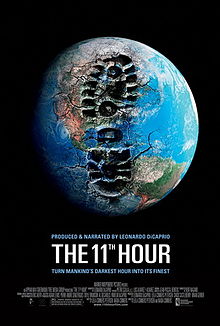
Yesterday's documentary, which was the last film of this semester, was The 11th Hour, a film everyone needs to watch  and I believe you can watch it free here, click !
Some  fifty prominent scientists and activists talk -- with wonderful visuals behind them -- about the state of the earth.  Which is, in a word, DIRE!

One person in our group remarked "You're preaching to the choir."  Very true.  Many things in the film hit home dramatically but one I mentioned in the discussion was that one of the speakers said that industrialization is the environment's greatest enemy.  And there was plenty of reason to believe him.  But, as I said, I have spent the 12 weeks of this semester in a course about the economic development of Southeast Asia (read, industrialization since WWII and continuing rapidly). Southeast Asia includes (with others) three of the world's four most populous countries: China, India and Indonesia. These three are industrializing very, very rapidly, which simply means enormous destruction of natural resource, enormous pollution and enormous need to feed literally billions of people all of whom also hope to achieve a standard of living similar to America's. (America is the fourth largest population).  They are not going to stop their growth unless something cataclysmic happens.  Nor is America. although some people suggested that Americans have been traditionally capable of great change under duress and that they can hope the now generally comfortable Americans can learn frugality and change their demanding ways.

My feeling is that won't be enough.  Many voices suggested -- yes, the doom sayers! -- that, just as, at the end of the Permian age the earth became uninhabitable to many life forms and 95% of them died off, we may be at such a state in a very short time -- how short?  We don't know.  We do know degradation of the earth is happening far faster than the doom sayers of the 1970s, who began the alarm, even imagined.  Watch this film!!!  Knowing what's going on in the world is far better than not knowing.  All that happens when an ostrich puts his head in the sand is he makes his ass a prime target for attack.

Monday, December 3, 2012

Lincoln, the new movie

The myth remains and seems less a myth and more a magnificent fact even though I understand perfectly well that this is a movie, not a documentary.  Lincoln directed by Steven  Spielberg, with Daniel Day-Lewis in the title role and the screenplay by Tony Kushner. Sally Fields is the always pained Mary Todd, tiny, decked out in extravagant gowns, while her husband seems to have one suit and never wants to wear his gloves. Beard and make up and many low angle, upward camera shots make Linoln a towering figure although I believe his Marfan's syndrome made him more gangly than Day-Lewis can possibly be.

The movie is about the wheeling and dealing that got the 13th amendment passed--the passion needed to pass such an amendment against great odds in the House of Representatives. It's a kind of passion we have seen in almost no presidents, truly the stuff of myth. Kushner's language is pungent and totally believable among these men with their prejudices and personal agendas. Writer an director join forces brilliantly throughout. At the outset is an astonishing scene as the towering man enters a room in the White House where a small boy lies sleeping in front of a fireplace. The tall man folds himself down on the floor beside the the boy, speaks to him softly, wakes him enough for the boy to climb on his back and be carried to his bed. Has any movie ever opened with such a quiet but dramatic picture of fatherly love?  Such a scene is not a part of the myth -- rather it was not, but now it is.

The movie is bracketed with some of Lincoln's most eloquent statements. At the beginning two black soldiers ask the President for true equality under the law; they quote the Gettysburg address, taking turns speaking the lines until they have to move away and a white soldier finishes the speech. At the end, as flashback, we see and hear Lincoln himself give the second inaugural address. These words are engraved in the memory of most of us even if we think we've forgotten them.

Superb acting throughout goes almost without saying.  Scenes are tight, sometimes almost claustrophobic, battlefield scenes are wrenching. I hope every Congressman in Washington will see this film and pause long enough to realize that nothing fine every happens without some compromises and some deep consideration of the future, rather than just the next election.