Sunday, July 31, 2011

Louise Erdrich

In the last couple of months I have come upon a couple of novels by Louise Erdrich. I began reading her work early in her career with, I think, The Beet Queen. I have just finished The Bingo Palace and will read a few other things before I pick up The Antelope's Wifee. Erdrich is a Native American writer. She writea about people associated with a Chippewa reservation [which I take to be based on a real one but hers is fictional] in North Dakota or Minnesota. Some of her stories are mostly straightforward narratives but some include a little or a lot of magic realism which is used to emphasize myth and native ways of thinking. I enjoy magic realism in the work of Central and South American writers and I like her way of handling it also.

Erdrich has created a cast of characters, some of whom reappear in various stories. I think of her as using them as Faulkner used his Yoknapatawpha County. They have wonderful names and they have complex family relationships. The Bingo Palace has two men, uncle and nephew, who are in love with the same woman. This story uses more magic realism than any other I've read yet. It is not a recent book, I cannot say she is tending in that direction because I think I've read later ones that are almost entirely without magic.

Mostly I prefer to ignore books by American writers because they write about a culture I know from the inside out. But Erdrich's stories take me to a world I do not know and always fascinate me. I feel she is writing truly about her culture, and I feel the same about Sherman Alexie, another writer I enjoy. A few minutes ago I was very delighted when I looked up some of the items on Google about Erdrich and discovered that we share a birthday, although she's about 15 years younger than I am.

Friday, July 29, 2011

Finding Things

Approaching the "dog days of summer" it's a quiet time, in a nice kind of way. I go out for my morning walks on the beach and then I have the day to divide between writing, quilting, reading and maybe an errand or two or maybe back to the beach in the afternoon for an hour. Lovely!

Today was a day of finding things. Last year I found a lot of horseshoe crabs, dead, on the beach, none this year until two days ago when a live one, big, old, bronzed was at the edge of the tide fighting to stay in the water. I could not see a way to help him so I had to let nature take its course. I think he survived as I didn't see him on the shore the next day. Today I realize the time of horseshoe crabs is at hand. I found three smallish ones washed up, dead. Last year some days I found a dozen or 15 on a single walk, I hope not this year. I hope they're surviving better.

Anyway I love finding them, even dead, because they are really fossils and I find them fascinating. Today was a day for finding things. Just a few feet beyond the parking lot was a quite nice patio table, white steel and plastic [imitation glass] top with a strip of masking tape saying FREE. I've been contemplating a white Adirondack chair for my little patio and was told where I could get one that actually folds for winter storage. With this table I'd have a comfy arrangement so I brought the table home.

Then, as I was about to complete my walk by the tide line I found, floating right on the water, a five dollar bill, sodden from quite a while in the ocean. So it seems the ocean is paying me for my exercise beside it. A good start to the morning and it's been a quiet, good day, although the sun disappeared about 9:30 and hasn't been seen since. It'll be back in full force probably tomorrow and I'll have a nicely cool night's sleep.

Thursday, July 28, 2011

An explanation

Since reading Cutting for Stone, as I said in the post below, I've not really understood the reference. Rachel who read the book too was also mystified and she was ambitious enough to do some research which I quote:

Human beings have known of bladder stones ("vesical calculi") for thousands of years, and have attempted to treat them for almost as long. The oldest bladder stone that has been found was discovered in Egypt around 1900, and it has been dated to 4900 BC. The earliest written records describing bladder stones date to before the time of Hippocrates (ca. 460-370 BC). However, lithotomy was a fairly common procedure in the past, and there were specialized lithotomists. The ancient Greek Hippocratic Oath includes the phrase: "I will not cut for stone, even for the patients in whom the disease is manifest; I will leave this operation to be performed by practitioners," a clear warning for physicians against the "cutting" of persons "laboring under the stone"; an act that was better left to surgeons (who were distinct from physicians at that time in history). Operations to remove bladder stones via the perineum, like other surgery before the invention of anesthesia, were intensely painful for the patient.[1]

In short, it is surgeons who do the really hard work of "cutting for stone." Since the pivotal characters in the novel are all surgeons of one type or another and many difficult [and blood] surgeries are described in the book, and the surgeons happen to be very skilled, they are the ones who must "cut for stone." A pun is involved as well, as Stone is the last name of the protagonist and his twin brother and, of course, their father.

I am appropriately humbled because I was too lazy to do the research myself -- in our Google-era such research is so easy not to do it is indeed lazy. In an earlier time ignorance about these "minor" but curious things might be excusable but it no longer is. i think I've just learned a les

Tuesday, July 26, 2011

Cutting for Stone, Abraham Veghese

"I Like Big and Long," is the teasing title of an essay I wrote a month ago about my preference for expansive novels with big themes. Cutting for Stone, Abraham Veghese,M.D.'s first novel fits that description very well and I enjoyed the long read very much especially because I like novels set in exotic countries I've never visited, in thie case mostly Ethiopia. I also enjoy "true" medical desxsriptions, in this case mostly sugery. I have read some of Dr. Verghese's essays in the NY Times Science Section and always found hin a very patient-centric doctor. This, his first novel, is a medical centric story, there are four M.D.s who are all as brilliant and dedicated and caring as we all wish our doctors were [and usually aren't]. I was a little bothered because they were so heroic and yet it's like reading about knights on a crusade, they need to be truly good.

The story gives us lots of drama, the frision of identical twins who have very different personalities, and a goodly dollop of the politics of Ethiopia. Those are all enough for me as nothing is gauche or sentimental. Yes, all the dangling ends get tied up neatly at the end but that is a writer's impulse I understand very well. it's summer and this is not a sterotypical "Summer" or "beach" novel -- it's much better than that. Verghese is a multi-talented man, a distinguished career in medicine has somehow given him enough time to write essays, a couple of nonfiction books and this quite long novel. I hope he'll write more. I hope the titles make more sense -- I can't seem to wrap my head around the title. A minor problems.

Saturday, July 23, 2011

The Philosopher and the Psychopath

"One person with a belief is equal to the force of 100,000 who have only interests." The statement by John Stuart Mill was on the Facebook page of the man believed to have [alone] caused the deadly explosions in Oslo yesterday. He is the same man who went to a children's camp and shot eeveral children a few days ago. Clearly he is a madman, assuming the police are correct about his identity as responsible for both horrors. At the last report 90 people were killed in the explosions.

We are quick to blame cabals of terrorists for such attacks yet Mill's statement about the effect of one man with an overwhelming belief is obviously true. It was not quite one man -- rather it was two -- who committed the Oklahoma City attack, our home grown terrorists. They had a belief. I wonder what twisted belief would make a man shoot innocent children and then plant bombs in a busy building in a peaceful city? Perhaps I don't even want to know what the belief was.

To switch the idea around, from one person believing that violence is the way to express his belief, to one person doing good with an overwhelming belief, we have to think of Ghandi,

Mill contrasted belief with mere interests. Most of us have many interests; perhaps it is a good thing not very many of us have truly strong beliefs since violence seems so much easier than nonviolene.

Friday, July 22, 2011

Lucein Freud


It is sad to read that Lucien Freud has died. I saw a couple of exhibits of his work and was astonished at his portraits. I believe I saw the painting above, "Benefits Supervisor Sleeping" or I've seen photos of it -- it was sold a few yeas ago for $17 million, the most ever paid for the work of a living painter. I vividly remember his painting of Leigh [Brouly - perhaps misspelled]. Freud loved painting very large people on his ratty old sofa. These were fascinating paintings but I especially was moved by a portrait he did of his mother [properly clothed], a very real and lovingly painted picture. At a small show of drawngs at MoMA maybe three years ago there was a wonderful etching of one of his whippets done just as lovingly.

I don't need to write biographical material, it will be in the major papers tomorrow. I'm always very glad I lived in a place where I could see wonderful art. One of my youthful ambitions had been to live in such a place, although at that early age I had not understood that it had to be New York City.

Monday, July 18, 2011

Maine, Briefly

One has to realize that this picture of my daughter was being taken by me, therefore, I, too, had climbed half a mile up. If I had known what kinds of rocks I'd have to scale and scramble over and go down on the seat of my pants, I probably would not have undertaken the hike to the top of Acadia mountain. But we did it. And walked the little ridge to the next mountain where we met a couple perhaps ten years younger than I but each probably 100 pounds heavier. That was humbling even if they had come the easy way. As the woman said, "It was not trivial." I'm saying all this both to brag and to say to younger readers, yes, you can too. Not so long ago a woman with an artificial hip simply couldn't do it. My muscles were and still are stiff but I have no pains. I feel like preaching about using or losing it. I say to all USE IT!

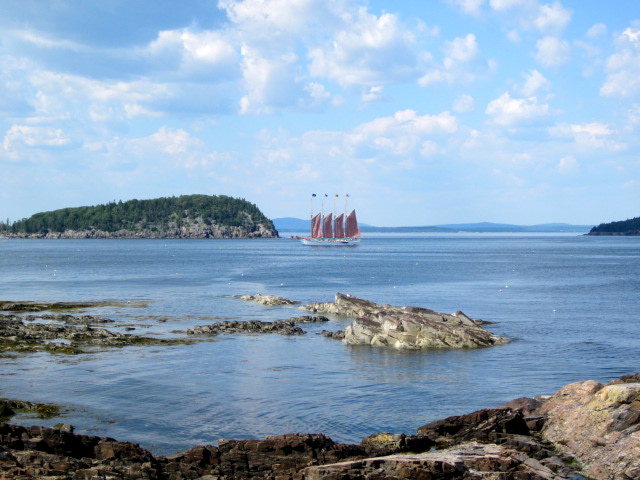
This is the kind of spectacular view one expects along the coast. That's a four masted schooner off Bar Harbor. The coast is just as dramatic and spectacular as I expected. The summer weekend couldn't have been lovelier, including a full moon outside our harbor view motel room's patio that reflected on the water and docked boats. I had borrowed Poetry Speaks from the library so we listened to poets reading their works as we drove and were delighted to find a very elegant garden in Camden a statue of Edna St. Vincent Millay who grew up there. She is a giant beside me but I tried to emulate her with a physical pose. I can't really say with her that "I burn my candle at both ends" but it's given me "a lovely light" and continues to do so.